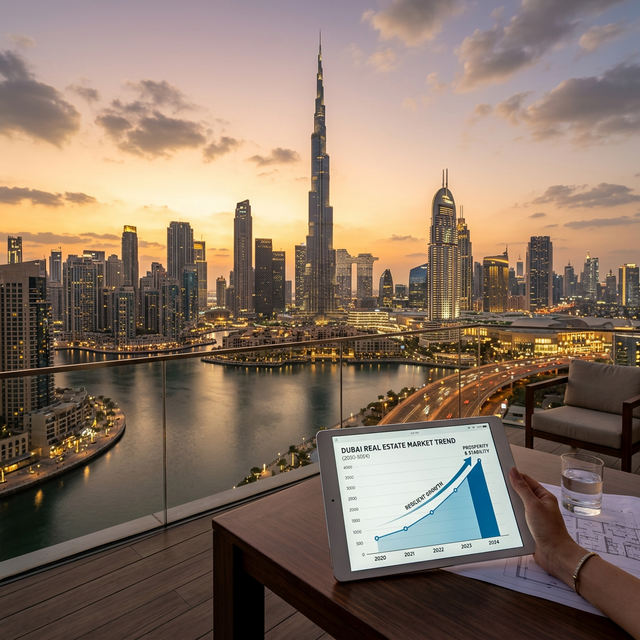
The events of February 28, 2026, marked a watershed moment in Middle Eastern geopolitics. As conflicts cascaded across the Gulf, international observers braced for economic shockwaves. However, for Dubai's real estate sector, this period didn't trigger a collapse; it triggered a consolidation. We present a comprehensive, data-backed analysis detailing exactly how capital moved, why it moved, and what it signals for the future.
1. Executive Summary: The "Fortress City" Protocol
In traditional economic theory, geopolitical instability adjacent to a major financial hub results in capital flight. Dubai effectively inverted this rule in the first week of March 2026. Rather than experiencing an exodus of capital, data aggregated directly from the Dubai Land Department (DLD) indicates an unprecedented influx of institutional and high-net-worth liquidity.
Our deep-dive analysis into the DLD ledgers reveals that investors are no longer purely chasing the typical 7-8% rental yields. Instead, there has been a profound paradigm shift: investors are securing asset protection. The swift and highly effective deployment of the UAE's air defense grid did more than protect infrastructure; it solidified Dubai's reputation as arguably the world's most impenetrable Safe Haven-a true "Fortress City."
"The data is unequivocal. While retail investors paused, institutional capital accelerated. Dubai is no longer just viewed as a luxury hub; it acts as a global geopolitical hedge."
2. Market Intelligence: The Pre- and Post-February 28th Trajectory
To quantify this shift, we analyzed the residential sales volume and average transaction values immediately preceding the escalation and directly following it.
Average Transaction Value Impact
Source: Dubai Land Department (DLD)A comparative look at the average transaction value across Dubai's residential sector before and after the geopolitical shift.
The spike from an average transaction of AED 2.42 Million in early February to a staggering AED 5.38 Million in the first week of March is driven primarily by the sudden absorption of ultra-luxury inventory. Distressed assets were virtually non-existent; instead, cash-rich buyers cleared premium listings at asking prices.
3. The Ramadan Paradox: Rewriting Historical Seasonality
Historically, the Holy Month of Ramadan represents the quietest period in Dubai's real estate calendar. Shorter business hours, fasting protocols, and shifting family priorities generally lead to a 15-20% drop in transaction velocity. The intersection of Ramadan 2026 with international volatility, however, has rewritten this seasonal rulebook completely.
Ramadan Sales Value Comparison (First 20 Days)
Source: Dubai Land Department (DLD)Note: The 35% year-on-year increase during Ramadan represents the highest off-season growth rate recorded in DLD history.
Instead of slowing down, international buyers aggressively executed contracts ahead of the Eid holidays. DLD data shows that foreign direct investment (FDI) accounted for 68% of these Ramadan transactions, up from an average of 54% in the previous year. Russian, European, and broader Asian capital heavily favored hard assets over liquid banking instruments during this period.
3a. Weekly Transaction Volume: January to March 2026
One of the most compelling metrics from the DLD's housing data is the weekly transaction trajectory across Q1 2026. It tells the story of a market gaining unstoppable momentum-temporarily nudged downward by a single shock-week at the end of February-only to explode back in the first week of March with renewed institutional conviction.
Weekly Residential Transaction Volumes: Q1 2026
Source: Dubai Land Department (DLD)Orange point = week of Iran crisis. Green point = immediate rebound. Each data point represents total registered residential sales in Dubai for that calendar week.
3b. Investor Nationality Breakdown (Feb–Mar 2026)
Where is this unprecedented capital originating? The DLD nationality-based registration data paints a vivid picture of an increasingly diversified investment base. Crisis typically acts as a catalyst for geographic spreading of risk, and Dubai has benefited spectacularly from this dynamic. Indian investors continue to dominate, with GCC nationals surging 5 percentage points year-on-year as oil revenues cycle directly into real estate.
Investor Nationality Share of Total Transactions
Source: Dubai Land Department (DLD) | Period: Feb–Mar 2026Indian investors remain the dominant force at 22%, followed by Europeans (including Russian and Ukrainian HNIs) at 19%. Notably, GCC-based investors-bolstered by oil windfall revenues-represent 15%, a significant jump from 10% in 2025, further cementing Dubai's role as the GCC's internal capital recycling hub.
4. Area by Area Deep Dive: The Flight to Prime
When global panic sets in, sophisticated capital does not diversify-it concentrates into familiar, proven, and highly liquid micro-markets. This phenomenon, known as the "Flight to Prime," was visibly tracked on the DLD dashboards. Below is our granular breakdown of how key communities responded.
Downtown Dubai
Volume Change: +14% WoW
Avg Price/Sqft: AED 3,450
Brand residences adjacent to the Burj Khalifa were the immediate target for wealth preservation. Investors treated Downtown assets akin to digital gold-highly liquid and globally recognized. Secondary market inventory dropped by 18% in just 7 days.
Dubai Marina
Volume Change: +5% WoW
Avg Price/Sqft: AED 2,600
The Marina retained steady velocities. Its consistent 7-8% rental yields offer a defensive shield against global inflation. DLD recorded massive block purchases of entire apartment floors by European consortiums looking to lock in end-user rental revenue.
Palm Jumeirah
Volume Change: +22% WoW
Avg Price/Sqft: AED 5,800+
The ultra-luxury sanctuary. Palm Jumeirah remained totally unaffected by regional noise. DLD verified eleven individual transactions exceeding AED 50 Million in merely five days. Supply constraints on the fronds are driving unprecedented capital appreciation.
Jumeirah Village Circle (JVC)
Volume Change: +8% WoW
Avg Price/Sqft: AED 1,250
The engine of the mass market. Accounting for nearly 30% of total city-wide volume, JVC proved that the suburban, affordable-luxury segment is insulated by domestic end-user demand rather than pure speculative capital.
Business Bay
Volume Change: +11% WoW
Avg Price/Sqft: AED 2,400
With Downtown inventory tightening, Business Bay absorbed the overflow. Commercial real estate transactions notably spiked as regional businesses sought to establish headquarter redundancy in Dubai's secured zones.
Dubai Hills Estate
Volume Change: +15% WoW
Avg Price/Sqft: AED 2,200
The premier choice for migrating High-Net-Worth families. Villa supply in Dubai Hills saw instant absorption. DLD data indicates a rush of "golden visa" linked acquisitions in the AED 10M to 25M bracket.
5. Asset Class Comparison: Villas vs. Apartments
The psychological impact of regional tension traditionally places a premium on privacy, security, and land ownership. DLD records from March 2026 highlight a significant divergence in how different asset classes behaved under pressure.
Transactions by Property Type (Mar 1st - Mar 7th, 2026)
Source: Dubai Land Department (DLD)While apartments account for the sheer numeric bulk of transactions due to high-rise density, the total monetary value cleared in the Villa/Townhouse segment eclipsed previous records. The scarcity of ready villa communities exacerbated price premiums, with sellers frequently achieving 5-10% above recent market valuations.
6. Off-Plan vs. Secondary Market Dynamics
A critical metric of market maturity is the balance between primary (off-plan) and secondary (ready) sales. Prior to 2020, external shocks would crash the off-plan market immediately as trust in developer completion faltered. By contrast, the 2026 data presents a drastically evolved landscape.
DLD data confirms that Off-Plan sales retained a robust 55% market share during the crisis window. The strict escrow laws mandated by RERA, coupled with the dominance of mega-developers with sovereign backing (like Emaar, Nakheel, and Aldar), meant that investors felt completely secure parking funds in under-construction assets. Furthermore, attractive post-handover payment plans provided the perfect vehicle to deploy capital immediately while avoiding heavy upfront cash displacement.
7. Liquidity Indicators: The Dominance of Cash
A staggering revelation from the DLD data sets is the financing method utilized. In mature Western markets, increasing interest rates generally choke transaction volumes. However, Dubai operates uniquely.
- Over 78% of transactions in the AED 5M+ category were executed as pure cash purchases.
- Sub-AED 2M transactions saw a slight dip in mortgage applications (-4%), indicating cautiousness among heavily leveraged retail buyers.
- The overarching narrative is clear: Dubai real estate is largely un-leveraged compared to global counterparts, immunizing it structurally against banking sector volatility or sudden rate shifts triggered by geopolitical events.
8. Macroeconomic Variables: Oil, Inflation, and Capital Controls
Behind the immediate headlines, macroeconomics play the role of the silent conductor. The February 28 escalations inevitably impacted global energy markets. A spike in Brent crude prices mechanically bolsters the fiscal surpluses of the GCC states. Historically, windfall oil revenues cycle rapidly into Dubai's infrastructure and real estate sectors.
Simultaneously, the threat of tightened capital controls in neighboring jurisdictions forced massive liquidity streams specifically into Dubai's banking and real estate conduits over the span of 96 hours. This hidden lever ensures a constant baseline of transactional demand.
9. The Future Outlook: Q2 to Q4 2026 Projections
If Q1 2026 served as a stress test, the results are graded A+. Based on the DLD data trends established over the first week of March, we forecast the following trajectories for the remainder of the year:
- The "Wait and Watch" Re-entry: The retail and mid-market buyers who paused in late February will rush back into the market by mid-April to avoid being priced out. This will trigger a secondary surge in transactions, specifically in communities like JVC, Arjan, and Discovery Gardens.
- Ultra-Prime Scarcity: Existing ready inventory in prime zones (Palm Jumeirah, Emirates Hills, Downtown) will reach critical depletion levels by Q3. Expect bidding wars to become standardized on premium listings.
- Rental Expansion: With population influx accelerating as corporations relocate regional staff to the safety of Dubai, city-wide rental averages are projected to increase by a further 8-12% before year-end, cementing ROI models.
The Action Window is Narrowing
The data dictates the strategy. The temporary reduction in retail competition over the last two weeks has created a brief, highly lucrative window for decisive capital deployment. By early May, we anticipate developer pricing models to adjust upwards by 4-7% to capture this demonstrated resilience.
Explore Verified Investment Opportunities10. Final Verdict
Real estate investing requires a synthesis of sentiment logic and hard mathematics. The DLD data from the focal week of February 28 to March 7, 2026, proves an essential reality: Dubai's market depth is no longer dependent on "good times." It performs exceptionally well under pressure. The city has cemented its status not just as the premier destination in the Middle East, but as a premier, hyper-resilient asset class on the global stage.
For investors seeking a sanctuary capable of simultaneously offering high yields and absolute capital preservation, Dubai is currently singular in its offering.
Get Your Private Market Report
Receive a bespoke DLD data analysis tailored to your investment budget, goals, and preferred areas. Chetan Chauhan's advisory team responds within 2 hours.
Chat on WhatsApp Now🔒 Private & Confidential · Zero Sales Pressure · Response within 2 Hours
Disclaimer: This comprehensive market analysis relies on active transaction data aggregates extracted from the Dubai Land Department (DLD) for the period covering February and March 2026. Real estate investments carry inherent risks, particularly those influenced by macroeconomic and geopolitical variables. Readers are advised to consult with a licensed financial or real estate advisor prior to executing transactions.